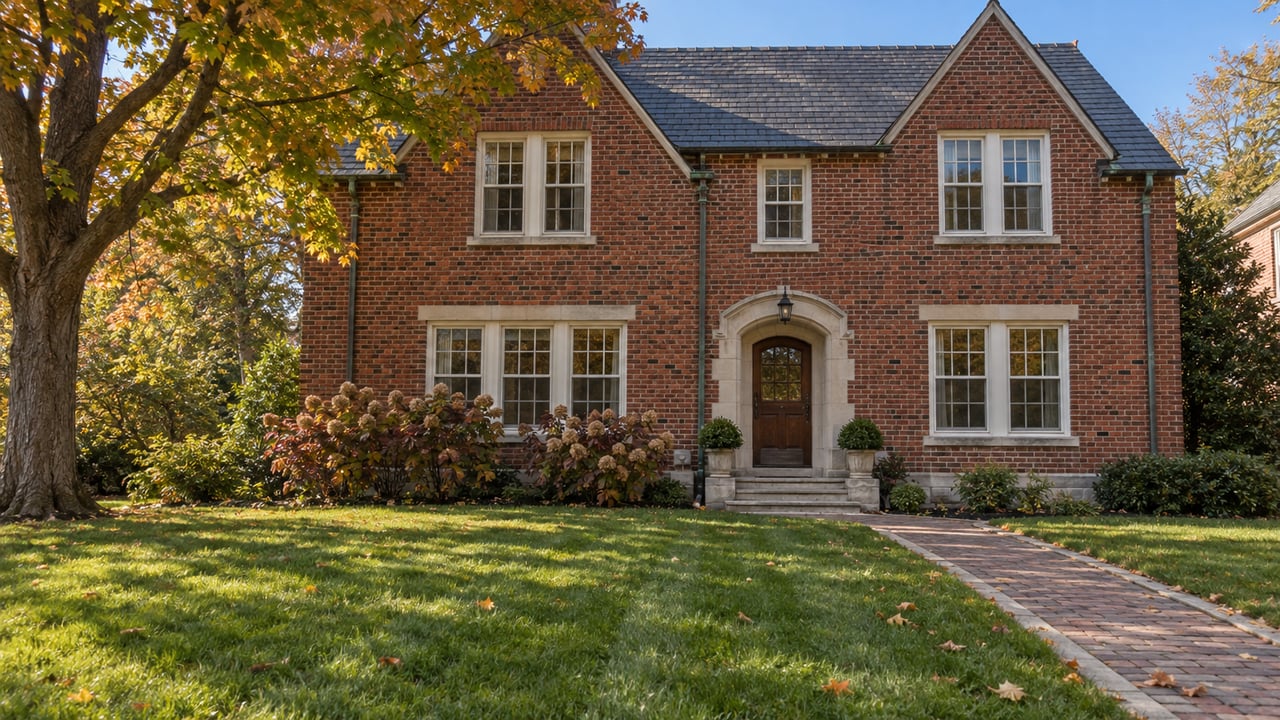
In 2025, Legacy Homes Cimala paid $2.2 million for the 1869 house at 142 E. First St. William M. Whitney, the state representative behind Hinsdale's 1873 incorporation, once owned it. A generation of TV viewers knows it as the "Hallmark House" from 1970s commercials. The plan was to replace a house of under 4,000 square feet with a 6,840-square-foot spec home with a four-car garage, aimed at a sale in the $7 million range. The Historic Preservation Commission voted no unanimously, and so did the seven-member Village Board. The Real Deal reported that the builder's answer was short: "They can't stop me. The way this is set up, all that they can do is advise."
He was right about the rules. On September 21, 2026, the village's monthly permit report listed a $40,000 residential fire-suppression permit at 142 E. First St., issued to Legacy Homes Cimala.
Hinsdale's preservation incentives are built around that limit. The village can't forbid most teardowns, so it competes with them by offering more room. For anyone shopping older homes here, the most important question about a house may be whether it's on a list most buyers have never heard of.
The Vote That Is Only Advice
The Village of Hinsdale's historic preservation page separates two kinds of review. Review of locally designated landmarks is binding. Review of properties in a historic district that aren't also local landmarks is advisory. Most older homes in the Robbins Park Historic District fall into the second group.
This spring showed how that works from the other side. At its April 1 meeting, the commission held a hearing on 305 S. Garfield, a Colonial Revival from around 1910 that a 2008 survey classified as a contributing structure in the Robbins Park district. The owner wanted to demolish it and build a contemporary home. Commissioners approved both certificates 5-0, on the condition of more brickwork on the north facade, which faces Union Church of Hinsdale. The Hinsdalean noted that the homeowner "can build the home with or without village approval." The village's May 2026 permit report then recorded a demolition and new single-family home project at that address.
These projects aren't rare. We went through the village's monthly permit reports for 2026 and counted at least ten addresses with demolition and replacement-home work through September. That's our own count, not an official village total. Four came in February. April, June, July and September had one each, and May had two.
The money behind a teardown starts with the lot. When the Hallmark House was on the market, The Hinsdalean reported that open-house visitors were focused on the 0.69-acre lot, and the listing agent said the land was worth more than the house. After buying it, Cimala told trustees the foundation repair estimate alone was almost $400,000, The Hinsdalean reported in September 2025. If the house adds nothing, a buyer is pricing what the lot allows them to build.
So the Village Pays in Square Feet
Hinsdale's answer has been the Historically Significant Structures Property List, launched in 2023. To qualify, a home must be in the village's Historic Overlay District and meet just one of six criteria. Most of those criteria involve distinctive architecture or a link to a significant person or event in village history. Listed owners can apply for alternative zoning, zoning variations, permit fee waivers and expedited processing. Property tax rebates and matching grants also need Village Board approval.
The zoning relief is what changes the comparison. Trustee Alexis Braden, a former historic preservation commissioner, put it simply to The Hinsdalean in May 2026: "We're going to allow you to build bigger on your lot than if you tore down."
That flips the usual math. A builder tears down to get a bigger house. On a listed property, keeping the old house can be the way to get the bigger house.
By that May report, 102 homes had joined the list in three years and two months, beginning with 47 in March 2023. Three came off after demolition: 505 S. County Line Road, 114 S. Stough St. and 142 E. First St. The village's updated list added 405 W. Sixth St. and 633 S. Washington St. with approvals dated June 30, 2026.
The village reports nearly $246,000 in fee waivers, $160,000 in grants and $137,000 in property tax rebates over the next five years, tied to more than $12 million in construction. Not every project is a big addition. The owners of 518 S. Garfield Ave. used the program for a leaky 100-year-old slate roof. Village planner Bethany Salmon pointed to 420 S. Park Ave., a 1923 French eclectic house that has been restored. She said people had called it "not salvageable."
The timing detail matters most in a transaction. Getting listed takes about three months from first contact, and Salmon said, "A lot of these homes got on the list when they were actually being marketed for sale." A house's status can change while it's on the market.
Three Versions of the Same Old House
The same 1910 house can carry very different options depending on how it's classified. Here's how each status works under the rules described above:
| Status of the house | Who decides on demolition | Size incentive | Tax treatment available |
|---|---|---|---|
| In a historic district, not a landmark, not on the list | Village review is advisory | Standard zoning for a replacement | None tied to preservation |
| On the Historically Significant Structures list | Advisory unless the house is also a landmark, and staff work with owners on renovations | Zoning relief that can exceed teardown limits | Possible village rebates and grants, with board approval |
| Contributing in Robbins Park, or a local landmark | Binding review only for landmarks | Depends on listing | Possible state assessment freeze if eligible |
The State Adds a Clock
The third row comes from Illinois, not the village. The Illinois State Historic Preservation Office's assessment freeze holds an eligible home's assessed value at its pre-rehab level for eight years, then phases it up to current value over four more. Owner-occupied principal residences qualify if they are individually on the National Register, contributing in a National Register district, a local landmark, or contributing in an approved local district. As of June 2026, Hinsdale is on the state's list of approved local governments.
The threshold is tied to the purchase economics. Eligible rehab costs must reach 25% of the assessor's pre-rehab fair cash value, and that figure includes the land. The spending has to happen within a 24-month rehab period unless SHPO approves an extension, and the work must meet the Secretary of the Interior's Standards. In Hinsdale, land is a big part of a house's value, so the bar is higher than in most places. The freeze applies to assessed value, not the tax bill, so tax rates can still change. Selling the home, renting it out, or no longer using it as a principal residence cancels the freeze.
The National Park Service lists the Robbins Park Historic District as of November 26, 2008. Being inside the district isn't enough. Eligibility depends on whether the specific address is a contributing property.
Each Robbins Park Teardown Raises the Stakes for the Rest
At the 305 S. Garfield hearing, Historic Preservation Commission chair John Bohnen asked whether Robbins Park could lose its National Register status. "Many of us are concerned that, at some point in time, we're going to lose the designation as a historic district, because there's going to be very little left that emulates historic architecture," he said, according to The Hinsdalean. He added that losing the designation could also end the tax freeze benefit, which would tip the math further toward demolition.
That's the feedback loop. Every contributing house that comes down weakens the district designation that makes the freeze available to the houses still standing.
The finished-product side gives the other benchmark. In August 2026, a new home at 531 Kensington Court in The Eight, the eight-home enclave built by J Jordan Homes with MK Construction and Moment Design, closed from MK Construction for $2,345,000, according to deed records published by The Hinsdalean. In September 2025, the development had been advertised as starting at $2.6 million. In that same deed batch, DuPage-recorded Hinsdale sales from August 25 to September 17, 2026 ranged from $350,000 to $4,035,000. A buyer comparing an older house against new construction is comparing against numbers like these, not a market-wide median.
Questions That Shape an Offer on an Older Hinsdale House
- Is the house on the Historically Significant Structures list, or could it be? Listing allows zoning relief beyond what a replacement could get. The process takes about three months and can start while a home is being marketed.
- Is it a local landmark? Review of landmarks is binding. For homes in a historic district that aren't also landmarks, the commission's vote is advisory.
- Is it contributing in Robbins Park? That status affects whether the state assessment freeze is available. The freeze's spending threshold is measured against house and land together.
- What does the lot allow? The Hallmark House sale showed that buyers can treat a 0.69-acre lot as the main asset, which puts the house's value against the land's.
FAQ
Can Hinsdale stop a teardown in a historic district? For properties in a historic district that aren't also local landmarks, the village's review is advisory. The Hallmark House and 305 S. Garfield both moved toward demolition under that structure, one after a denial and one after a conditional approval.
Does the freeze lower property taxes? It holds the assessed value for eight years, followed by a four-year phase-in. Tax rates can still change, so the bill isn't fixed.
Do all listed projects involve big additions? No. Approved projects include a slate roof replacement at 518 S. Garfield Ave. and the replacement of non-original windows with more authentic ones.
Looking at an older Hinsdale house and trying to figure out whether you're buying a house or a lot? That's exactly the kind of question we love working through. Alexa Wagner and the team can help you sort out a property's status, the timing and the tradeoffs before you write an offer. Let's Connect.
This article is general information, not legal, tax or financial advice. Consult a qualified professional about your situation.